How Money Laundering Works: Placement, Layering, Integration
How Money Laundering Works: Placement, Layering, Integration
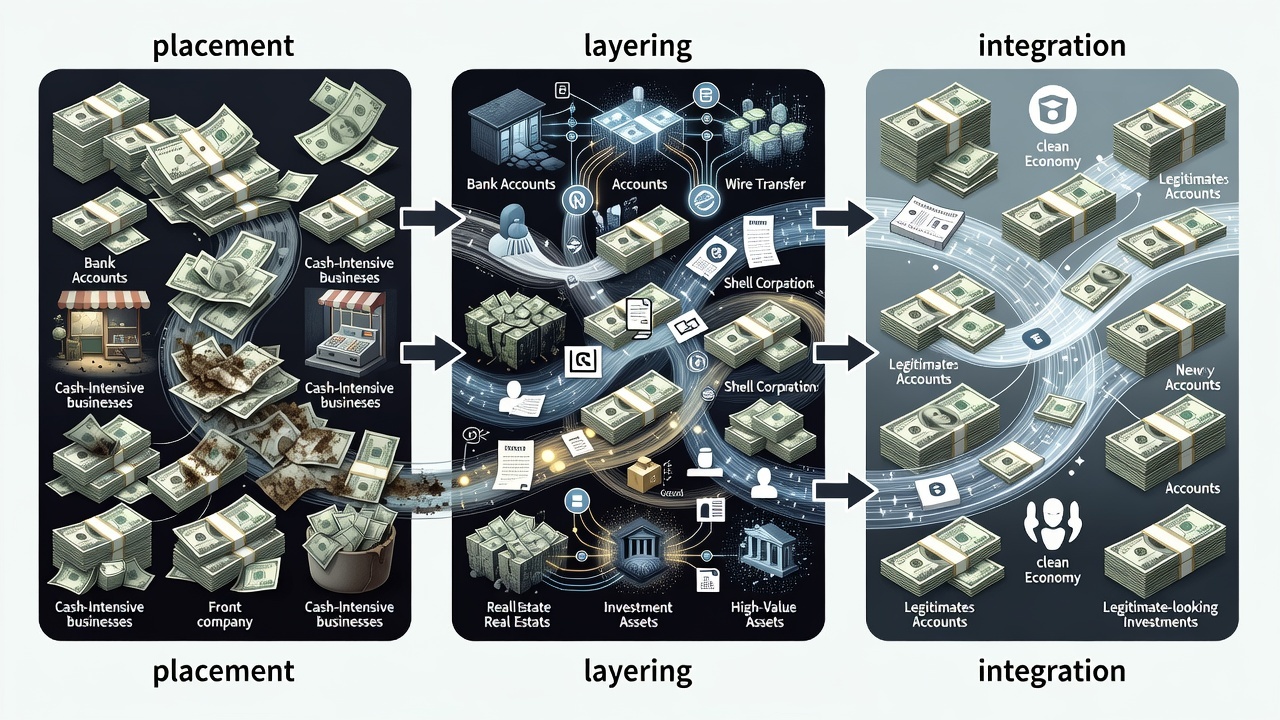
Introduction
Money laundering follows a predictable three-stage pattern. Understanding this pattern is essential because every control in AML — from KYC to transaction monitoring — is designed to catch criminals at one of these stages. This lesson explains placement, layering, and integration in detail.
The Three Stages
   STAGE 1          STAGE 2          STAGE 3
   PLACEMENT  -->   LAYERING  -->   INTEGRATION
   "get it in"      "move it"       "make it look legit"
        |               |                |
   dirty cash      complex chains    clean, spent money
Stage 1: Placement
Placement is the point where illegally obtained cash is first introduced into the financial system. This is often the riskiest stage because large amounts of cash are hard to handle and conspicuous.
Common placement methods:
- Depositing cash into bank accounts in small amounts (structuring/smurfing)
- Buying cash equivalents with cash
- Using cash-intensive businesses (e.g., a shop that mixes dirty cash with real takings)
- Currency exchange, money transmitters, or casinos
Stage 2: Layering
Layering is about separating the illicit funds from their source by moving them through a complex series of transactions. The goal is to make the audit trail so convoluted that it's extremely hard to trace the money back to the crime.
Common layering methods:
- Rapid transfers between multiple accounts and banks
- Moving money through multiple countries and currencies
- Buying and selling assets, property, or securities
- Routing via shell companies and trusts
- Using cryptocurrency mixers and high-volume exchanges
Stage 3: Integration
Integration is when the laundered money re-enters the legitimate economy and appears to be lawful. The criminal can now use the funds openly because it looks like ordinary income.
Common integration methods:
- Purchasing real estate, luxury goods, or businesses
- Paying "dividends" or "salary" from a shell business
- Investing in financial products
- Over-invoicing or under-invoicing in trade to justify large flows
The Full Cycle in One Example
1. Placement: A criminal deposits €90,000 of illicit cash through many small deposits (under the reporting threshold) across several accounts — this is structuring/smurfing. 2. Layering: The funds are wired to an overseas account, converted to a different currency, moved into a shell company, and used to "invest" in a trade invoice. 3. Integration: The shell company issues a "dividend" to its owner, who buys a house. The money now looks like legitimate investment returns.
   Cash -> many small deposits -> overseas wires ->
        -> currency change -> shell company -> invoice
        -> dividend -> house  =  money looks clean
Why the Stages Are a Useful Mental Model
For a compliance professional, the three stages are a checklist:
- Placement → look for cash patterns, threshold avoidance (structuring)
- Layering → look for rapid, complex, cross-border movements with no logic
- Integration → look for wealth/spending inconsistent with the customer's profile
Summary
- Placement: getting dirty cash into the financial system
- Layering: moving funds through complex transactions to hide the source
- Integration: making the money appear legitimate and usable
- Each stage has distinct red flags that monitoring and KYC try to catch
Next Lesson
Let's look at the specific methods fraudsters actually use — from smurfing to trade-based laundering.
Quiz - Quiz - How Money Laundering Works
1. Which is the correct order of the three stages of money laundering?
2. In which stage is 'dirty' cash introduced into the financial system?
3. The purpose of the 'layering' stage is to...