Common Money Laundering Methods Used by Fraudsters
Common Money Laundering Methods Used by Fraudsters
Introduction
Fraudsters are creative, but their methods follow recognizable patterns. This lesson walks through the most common money laundering typologies you'll encounter in compliance work — so you know what to look for and what your monitoring systems should be screening for.
Smurfing and Structuring
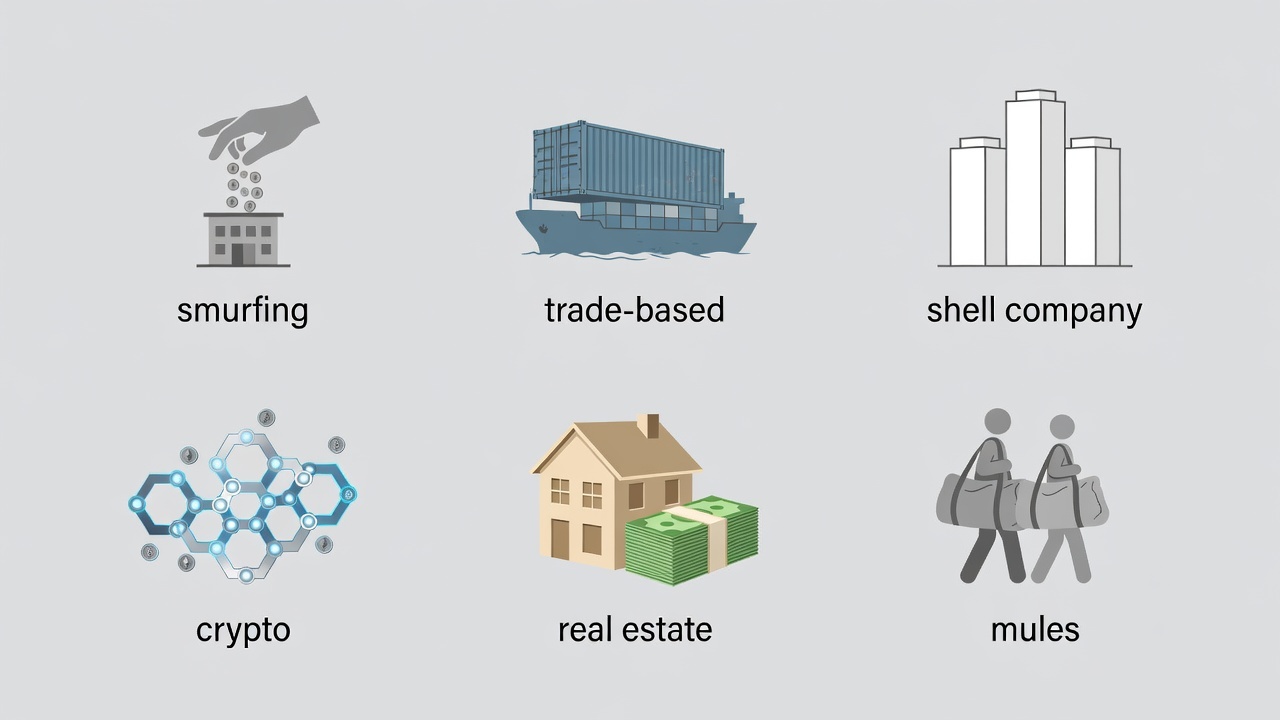
Smurfing (or structuring) is breaking a large sum of money into many smaller transactions to avoid reporting thresholds. Banks report large currency transactions (in the US, cash transactions over $10,000), so criminals deposit just under the threshold repeatedly.
   One large sum
        |
        v
   split into many small deposits
   each below the reporting threshold
Red flags: many cash deposits just under the threshold, multiple people depositing into one account, rapid deposits across branches/accounts.
Trade-Based Money Laundering
This abuses legitimate international trade to move value. Criminals misrepresent the price, quantity, or quality of goods in trade transactions.
- Over-invoicing: paying more than goods are worth, moving the excess as "payment"
- Under-invoicing: the reverse, to shift value
- Fake shipments: invoices for goods that don't exist or never move
Shell Company Laundering
Shell companies have no real business activity, yet they hold bank accounts and move money. Because ownership can be hidden through layers, they're ideal for hiding the true owner and destination of funds.
Red flags: a newly formed company with large, unexplained flows; no website or operations; complex ownership that's hard to trace; directors with many unrelated companies.
Real Estate Laundering
Real estate is a popular laundering vehicle because it's high value and lets criminals convert cash into a legitimate-looking asset. Property can be bought with laundered funds and later sold for "clean" money.
Red flags: purchases without financing, funds from unknown sources, ownership hidden behind companies or trusts, rapid buy-and-sell for profit.
Casino and Gambling Laundering
Casinos allow exchanging cash for chips and back. Criminals buy chips with dirty cash, gamble a little, and cash out "winnings" that look legitimate.
Red flags: large chip purchases and quick cash-outs, minimal actual gambling, multiple visits to cash out big amounts.
Cryptocurrency Laundering
Crypto offers pseudonymity and global, rapid movement. Criminals may use mixers/tumblers, privacy coins, peer-to-peer trading, or high-volume exchanges to obscure the trail.
Red flags: rapid in-and-out transfers, use of mixers, structuring across exchanges, transactions inconsistent with the customer's stated purpose.
Money Mules
A money mule is a person who receives and transfers stolen funds, often unknowingly or for a small fee. Mules help criminals move money while keeping the actual launderer hidden.
Red flags: a customer quickly receiving and forwarding money with no logical reason, new accounts receiving then immediately transferring large sums, funds from unrelated "employers."
Combining Methods
Real schemes often combine several typologies at once — say, structuring deposits, routing through a shell company, laundering via trade invoices, and finishing with real estate. Compliance teams should assume criminals use multiple layers, not just one clean trick.
The Compliance Response
For each typology you need:
- Policies describing what's monitored
- Scenarios/rules in transaction-monitoring systems
- Screening against lists
- Employee training so staff recognize red flags
- Escalation to file an STR/SAR when suspicion is confirmed
Summary
- Smurfing/structuring: micro-deposits to dodge thresholds
- Trade-based: invoice manipulation
- Shell companies: hiding ownership and movement
- Real estate, casinos, crypto, mules: further common vehicles
- Schemes usually combine multiple methods
- Monitoring must target each typology's red flags
Next Lesson
AML and CFT share tools, but terrorist financing has its own logic. Let's explore it — plus proliferation financing.
Quiz - Quiz - Money Laundering Methods
1. Smurfing (or structuring) refers to...
2. Trade-based money laundering typically involves...
3. Shell companies are often used in laundering because they...