Mutual Funds vs ETFs
Mutual Funds vs ETFs
Introduction
Instead of buying many individual assets, you can buy a fund — a pooled basket managed for you. This lesson compares the two main types: mutual funds and ETFs.
Mutual Funds
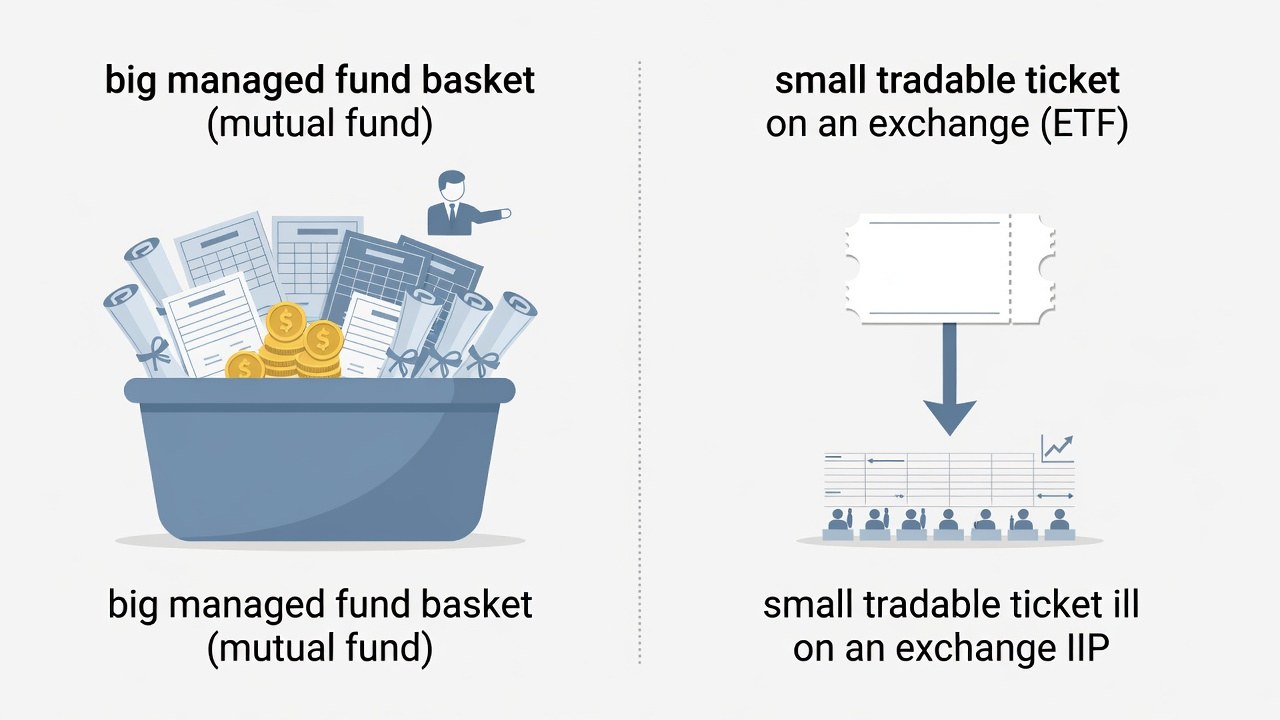
A mutual fund pools money from many investors and a professional manager invests it in a portfolio.
- Managed by professionals (active) or track an index (passive)
- Valued once per day at net asset value (NAV)
- Traded through the fund company, not on an exchange
- May have sales loads and higher fees
ETFs (Exchange-Traded Funds)
An ETF is a fund that trades on an exchange like a stock, during market hours.
- Bought/sold throughout the day at market prices
- Usually passive and low cost
- Transparent holdings
- Liquid and flexible
The Key Difference
Mutual fund:  traded once a day at NAV, through the fund
ETF:          trades on the exchange all day, like a stock
Why Funds Are Popular
Funds give instant diversification — one purchase spreads your money across dozens or hundreds of assets — with professional management (for active funds) and low minimums.
Which to Choose?
- Active mutual fund — if you trust a manager to outperform (fees higher)
- Passive index ETF — for low cost and broad market exposure
- For most long-term investors, low-cost index ETFs are the default choice
Summary
- Mutual funds are pooled, professionally managed, traded at daily NAV
- ETFs trade on exchanges like stocks, usually low cost and passive
- Both provide instant diversification
- Active funds have higher fees; index ETFs are generally cheaper
- Prefer low-cost index ETFs for most long-term investing
Next Lesson
How the most popular low-cost funds work — index funds.
Quiz - Quiz - Mutual Funds vs ETFs
1. A mutual fund is...
2. ETFs trade on exchanges...
3. The main advantage of funds is...
4. Which usually has lower fees?