Battery Chemistries: Lead-Acid, LFP, NMC, Sodium
Battery Chemistries: Lead-Acid, LFP, NMC, Sodium
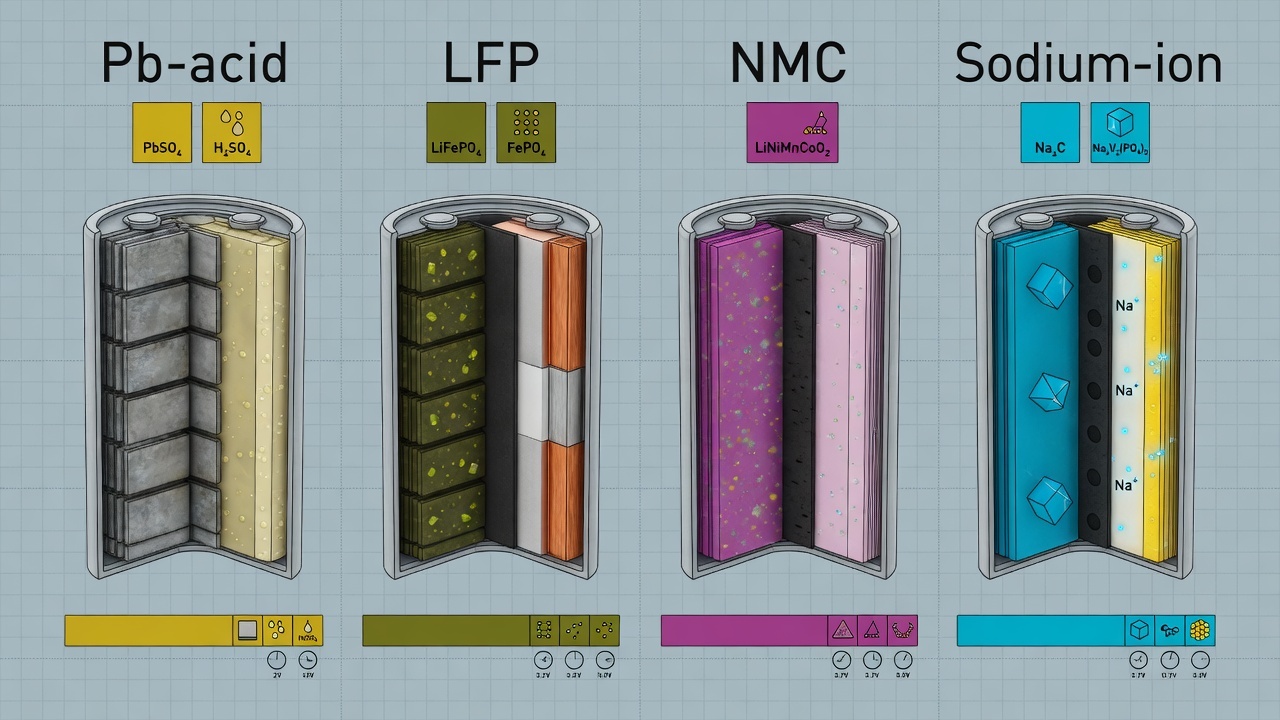
Introduction
Not all batteries are created equal. The chemistry inside a battery determines its cost, lifespan, safety, weight, and what it can do for a PV system. This lesson compares the chemistries you'll actually encounter: lead-acid, lithium iron phosphate (LFP), lithium nickel manganese cobalt oxide (NMC), and the promising newcomer — sodium-ion.
Lead-Acid
The oldest and cheapest technology, still used in many budget off-grid and backup setups (especially flooded, gel, or AGM types).
- Low cost per kWh (upfront)
- Low DoD — only ~50% typically
- Shorter cycle life — a few hundred to ~1000 cycles
- Heavier and bulkier
- Needs maintenance (flooded types) and ventilation (hydrogen gas)
- Sensitive to deep discharge and temperature
Lithium Iron Phosphate (LFP)
The dominant chemistry in modern residential and commercial storage. The most common choice for today's PV systems.
- Long cycle life — 4000-6000+ cycles
- High DoD — 90-100% usable
- Excellent safety — very stable chemistry, low fire risk
- Light and compact
- No maintenance
- Higher upfront cost than lead-acid, but far lower cost-per-cycle over lifetime
Lithium Nickel Manganese Cobalt (NMC)
A high-energy-density lithium chemistry, more common in electric vehicles than stationary storage. It packs more energy into less weight and space.
- Very high energy density
- High DoD and good cycle life
- Slightly higher energy density than LFP, but generally considered less thermally stable
- More common in EVs; appears in some storage products
Sodium-Ion (new!)
Sodium-ion is an emerging chemistry generating real excitement. Sodium is abundant and cheap, reducing cost and supply-chain risks versus lithium.
- Abundant, low-cost materials — sodium is everywhere, unlike lithium and cobalt
- Good safety and wide temperature tolerance
- Lower energy density than lithium (so far) — bulkier per kWh for now
- Competitive cycle life expected
- Not yet widespread in residential PV, but rapidly maturing
Comparison Table
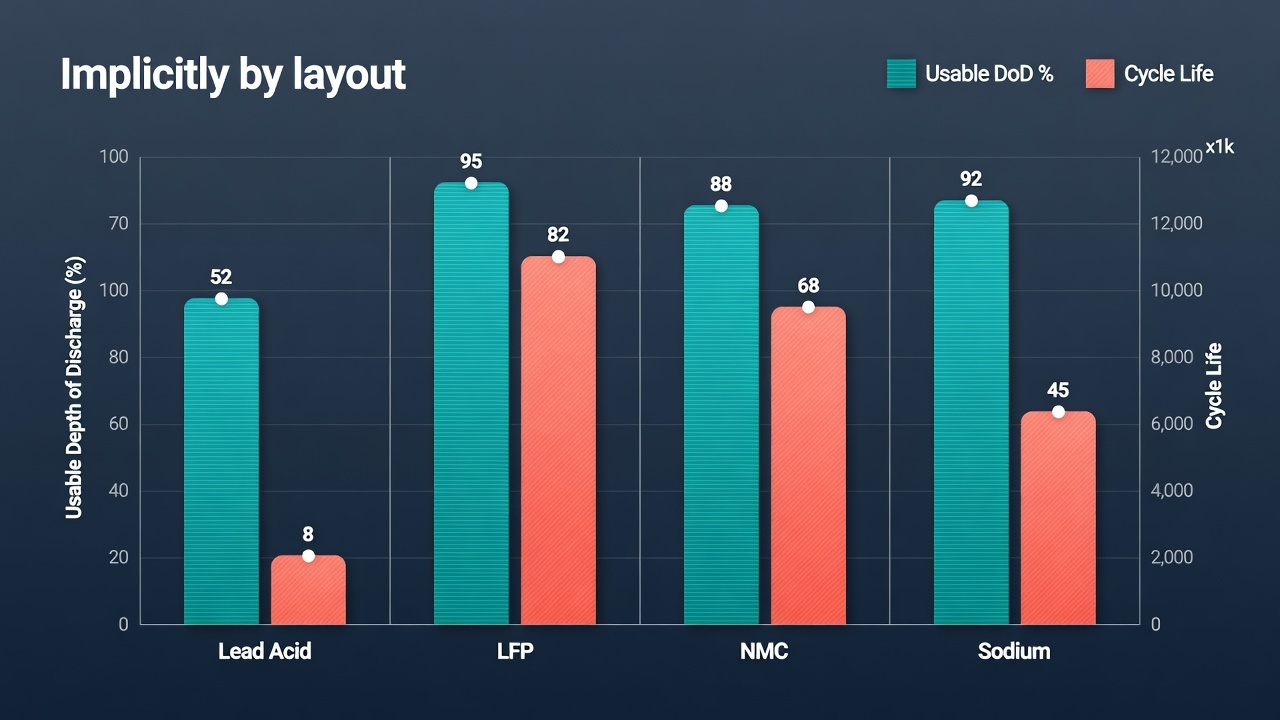
| Chemistry | Cost | DoD | Cycle life | Energy density | Safety | Common in PV? |
|---|---|---|---|---|---|---|
| Lead-acid | Low | ~50% | Low | Low | Fair | Budget systems |
| LFP | Med-High | ~90-100% | Very high | Medium | Excellent | Yes (most common) |
| NMC | High | ~90% | High | Very high | Good | Mostly EVs |
| Sodium-ion | Low (future) | High (expected) | High (expected) | Medium-low | Excellent | Emerging |
Which to Choose?
For residential PV storage, LFP is the clear default thanks to its balance of safety, longevity, cost-per-cycle, and high usable DoD. Choose NMC mainly when energy density is critical. Consider lead-acid only for the tightest budgets. Watch sodium-ion — it's positioned to shake up the market on cost.
Summary
- Lead-acid: cheap upfront, poor DoD/cycle life, budget niche
- LFP: the industry standard for PV — long life, high DoD, excellent safety
- NMC: high energy density, mostly EVs
- Sodium-ion: cheap, safe, abundant materials — the promising newcomer
Next Lesson
Now let's compare what a system looks like WITH a battery versus WITHOUT — the practical installation differences.
Quiz - Quiz - Battery Chemistries
1. Which battery chemistry is the most common in modern residential PV storage?
2. A key advantage of LFP over lead-acid is...
3. Sodium-ion batteries are considered promising because...