How Photovoltaics Work
How Photovoltaics Work
Introduction
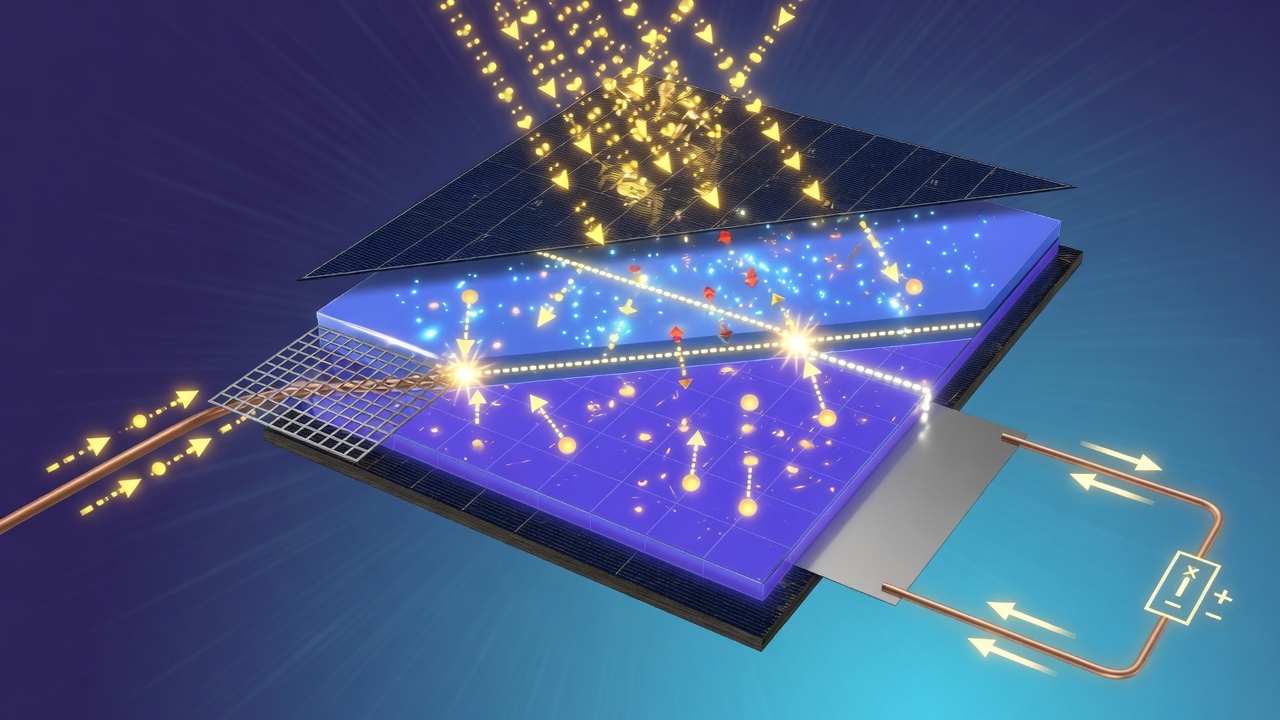
Photovoltaics (PV) is the direct conversion of sunlight into electricity using semiconductors. Unlike solar thermal systems that heat water, PV panels produce electrical energy the moment light hits them. This is the heart of every solar installation you will ever build.
The Photovoltaic Effect
The photovoltaic effect is the physical phenomenon that makes solar panels work. Inside every solar cell there is a semiconductor material, usually silicon, specially treated to create an electric field.
When a particle of light (a photon) strikes the cell, it can knock an electron loose from its atom. With the right structure, this freed electron is pushed toward an external circuit, creating an electric current.
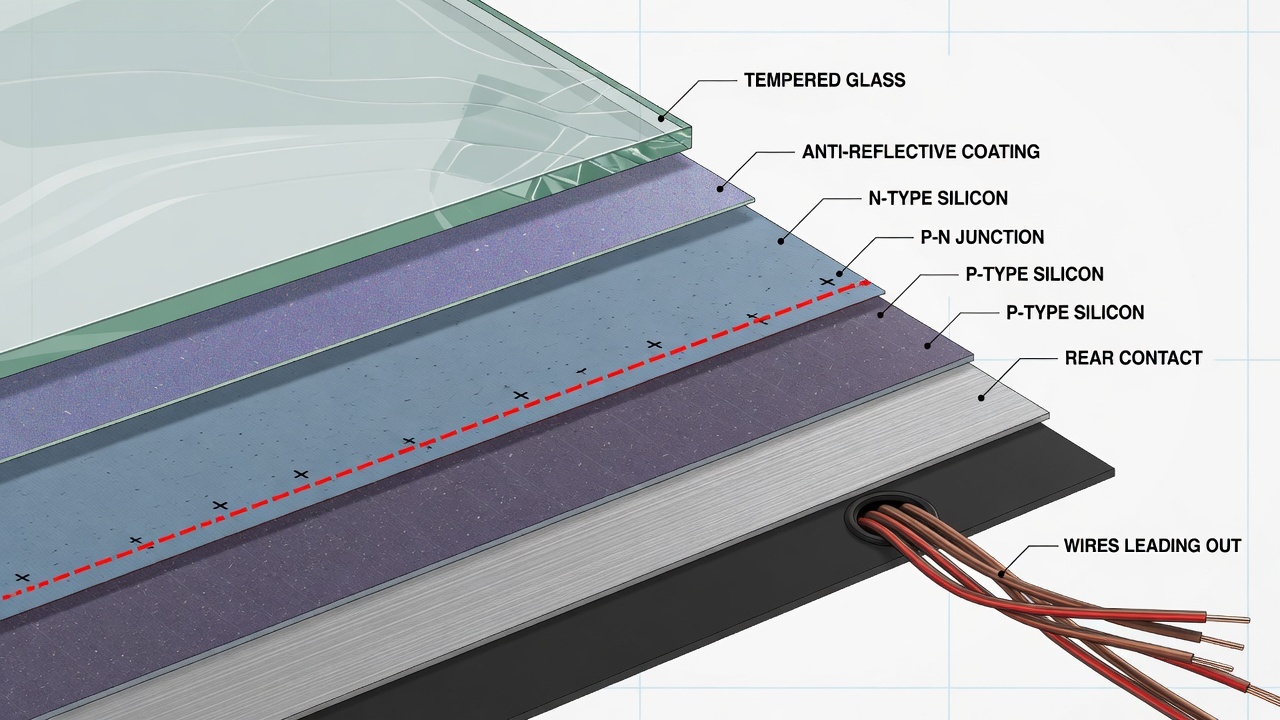
Every photon that frees an electron contributes to the current. More light means more freed electrons, which means more current and more power.
Every photon that frees an electron contributes to the current. More light means more freed electrons, which means more current and more power.
What a Solar Cell Produces
A single PV cell produces DC (direct current) electricity — the same kind a battery produces. A typical silicon cell generates only about 0.5 to 0.6 volts, not enough for real-world use alone. That is why cells are connected in series inside a panel to build up voltage.
From Cell to Panel to Array
- Cell — the smallest unit that produces power
- Module (panel) — many cells wired together in a protective frame
- String — several panels connected in series
- Array — one or more strings wired together
  Cell (~0.5V)  -->  Panel (many cells)  -->  String (panels in series)
                                                        |
                                                    Array (strings)
                                                        |
                                                     Inverter
The I-V Curve
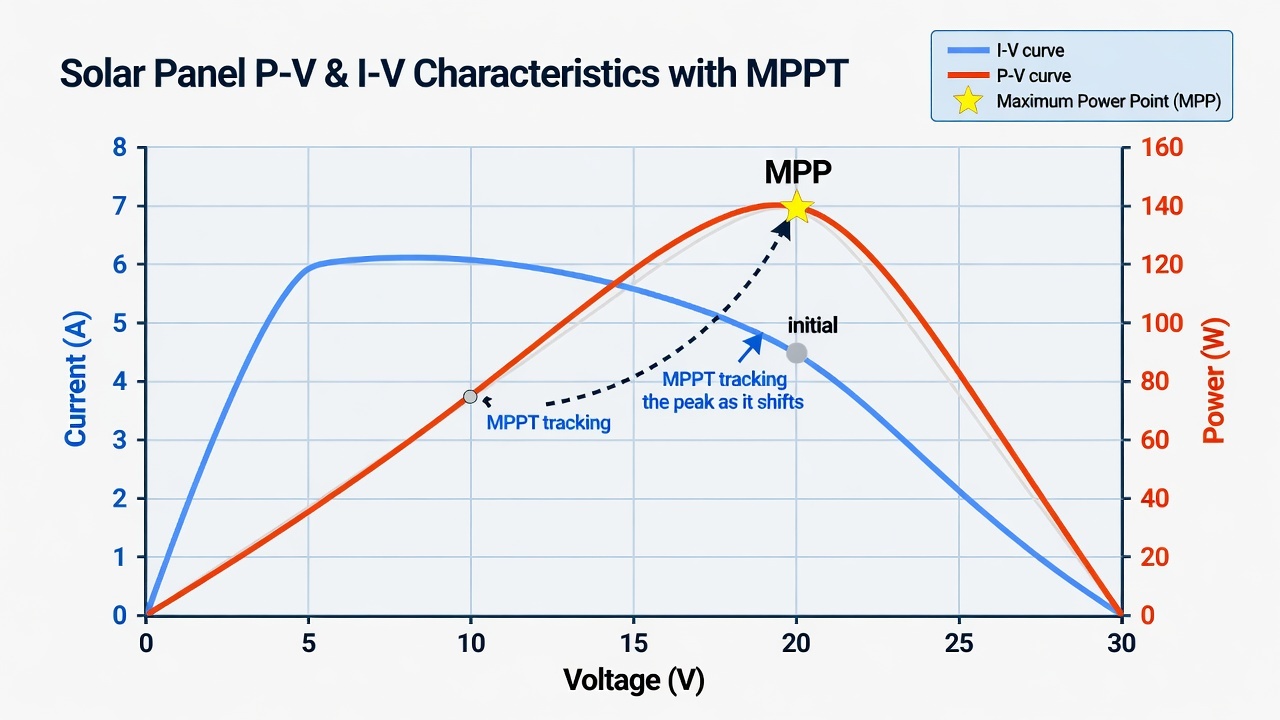
Every PV panel has a characteristic I-V (current-voltage) curve. As you increase the voltage drawn from the panel, the current stays roughly flat until a knee point, then drops sharply.
Current
   |   X-------.
   |   |        \        <- I-V curve
   |   |         \
   |   |          \
   |   |           \___.
   |   '-------------M--'----> Voltage
   +-----------------------------
            ^
            |
        MPP = Maximum Power Point
The Maximum Power Point (MPP) is the voltage and current combination where the panel delivers the most power. Finding and tracking this point is exactly what an MPPT (Maximum Power Point Tracking) controller does inside modern inverters.
Energy, Power and Units
- Power (W) — how fast energy is produced right now
- Energy (kWh) — how much was produced over time (Power × hours)
- A 400 W panel under full sun produces 400 W now, and roughly 400 Wh per peak sun hour
1 kWh = 1000 W x 1 hour
Real-World Example
On a sunny day, a single 400 W panel with 5 peak sun hours of good light produces about:
400 W x 5 h = 2000 Wh = 2 kWh per day
That is enough power for many common household appliances — and when you scale to 20 panels, you get a serious 40 kWh/day system.
Summary
- Photovoltaics converts light directly to DC electricity via the photovoltaic effect
- Photons knock electrons loose in a semiconductor, creating current
- Cells build into panels, strings, and arrays
- The I-V curve defines the panel's behavior, with the MPP as the sweet spot
- Power is measured in watts, energy in kilowatt-hours
Next Lesson
Now that you understand how a cell produces electricity, let's look at the different PV panel types and the key parameters on their datasheets.
Quiz - Quiz - How Photovoltaics Work
1. What physical effect converts sunlight directly into electricity in a solar cell?
2. A solar cell produces electricity from light because...
3. What type of current does a single PV cell naturally produce?