Main Components of a PV System
Main Components of a PV System
Introduction
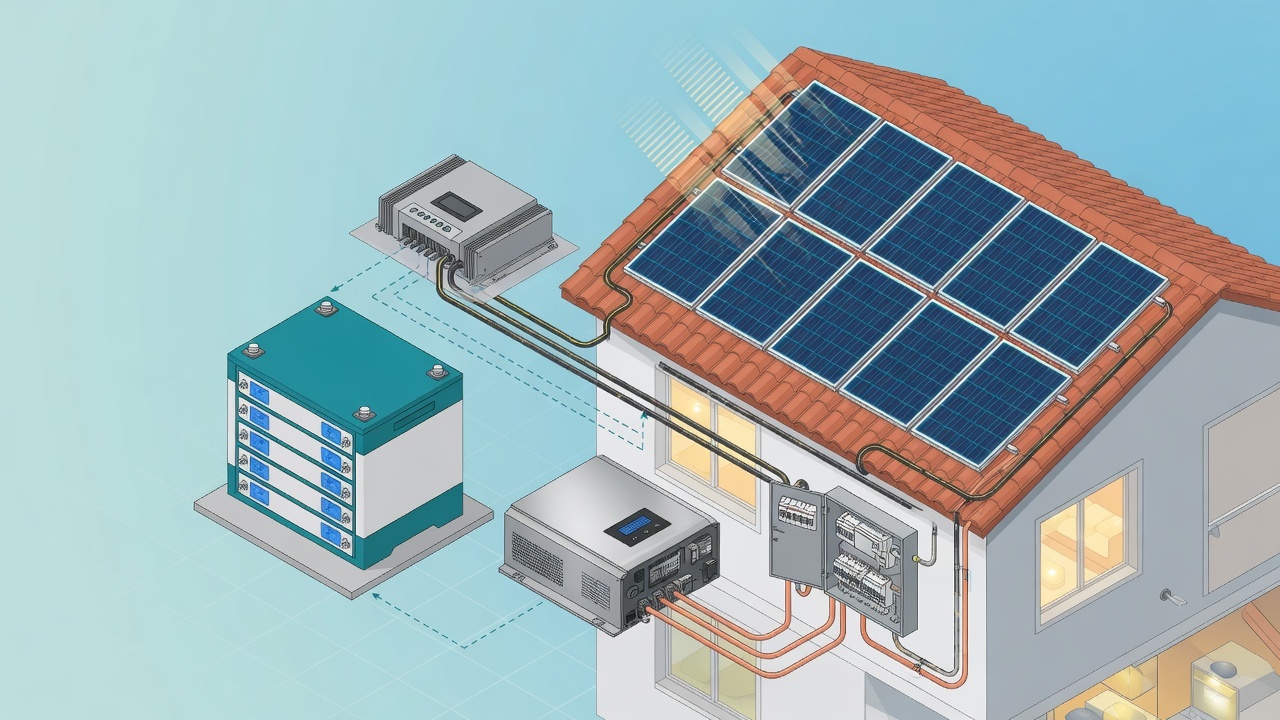
A PV system is made of several distinct building blocks, each with a clear job. Understanding how they fit together — and which side of the system they belong to (DC or AC) — is the foundation of every good installation. This lesson maps the full architecture.
The DC Side and the AC Side
PV electricity has two distinct "worlds" divided by the inverter:
- DC side — everything before the inverter: panels, string wiring, DC disconnects, DC fuses, charge controllers, and (in battery systems) the DC battery bank.
- AC side — everything after the inverter: the AC distribution board, breakers, and the loads or the grid.
   PV Panels (DC)
        |
        v
   DC Combiner / String wiring
        |
        v
   DC Disconnect + DC fuses
        |
        v
   [ CHARGE CONTROLLER --if battery-- ]  <-- DC battery
        |
        v
      INVERTER
        |
        v
   AC Distribution Board --+---> AC loads
                           |
                           +---> Utility grid (on-grid)
Component-by-Component
PV Panels
The energy source. Convert sunlight to DC power. Covered in detail in the previous lesson.
DC Combiner Box / String Wiring
Combines the output of multiple strings and provides fusing. In larger systems it's a dedicated combiner box; in smaller residential systems the strings may feed directly into an inverter with built-in fusing.
DC Disconnect Switch
A manually operated switch that safely isolates the DC side. Required so installers and emergency responders can de-energize the panels.
Charge Controller (for battery systems)
Regulates the charging of the battery from the panels. Two types:
- PWM (Pulse Width Modulation) — simpler, cheaper
- MPPT (Maximum Power Point Tracking) — more efficient, pulls maximum power from the panels
Inverter
The converter that turns DC into AC. It is the brain of the system. Modern inverters also host MPPT trackers, communication, and safety functions.
Battery (optional)
Stores energy for use when the sun isn't shining or during outages. In hybrid/off-grid systems it's a core component.
AC Distribution Board
The breaker panel that routes AC power to loads. Includes the grid connection point and, in on-grid systems, the grid meter.
System Roles vs Standalone Components
Note that a charge controller and an inverter are two distinct jobs:
- A charge controller only manages battery charging (DC→DC)
- An inverter converts DC→AC for loads/grid
- A hybrid inverter does both: it manages the battery AND produces AC for the house in one box
Real-World Example
A typical modern grid-tied home system might be:
20 x 400 W panels  = 8 kW DC
        |
        v
8 kW hybrid inverter (with MPPT)
   |           \
   |            \-> 10 kWh LFP battery
   v
Distribution board -> house + grid export
Summary
- PV systems split into a DC side and an AC side
- Panels, combiner, DC disconnect, charge controller, and battery are DC components
- The inverter is the bridge; AC loads and grid are on the AC side
- A charge controller manages the battery; a hybrid inverter does charge control AND AC conversion
Next Lesson
Let's explore the two fundamental architectures: grid-tied (on-grid) and off-grid systems.
Quiz - Quiz - Main Components of a PV System
1. Which component is used to convert the panel's DC output so it can power AC appliances?
2. In an off-grid system, which component manages charging of the battery from the panels?
3. Which of these is NOT typically part of a PV system's DC side?