Installation With vs Without Battery
Installation With vs Without Battery
Introduction
One of the first decisions in any PV project is whether to include battery storage. This lesson compares the two approaches side by side — the components, the behavior, and the pros and cons — so you can recommend the right answer for each customer.
System Without Battery
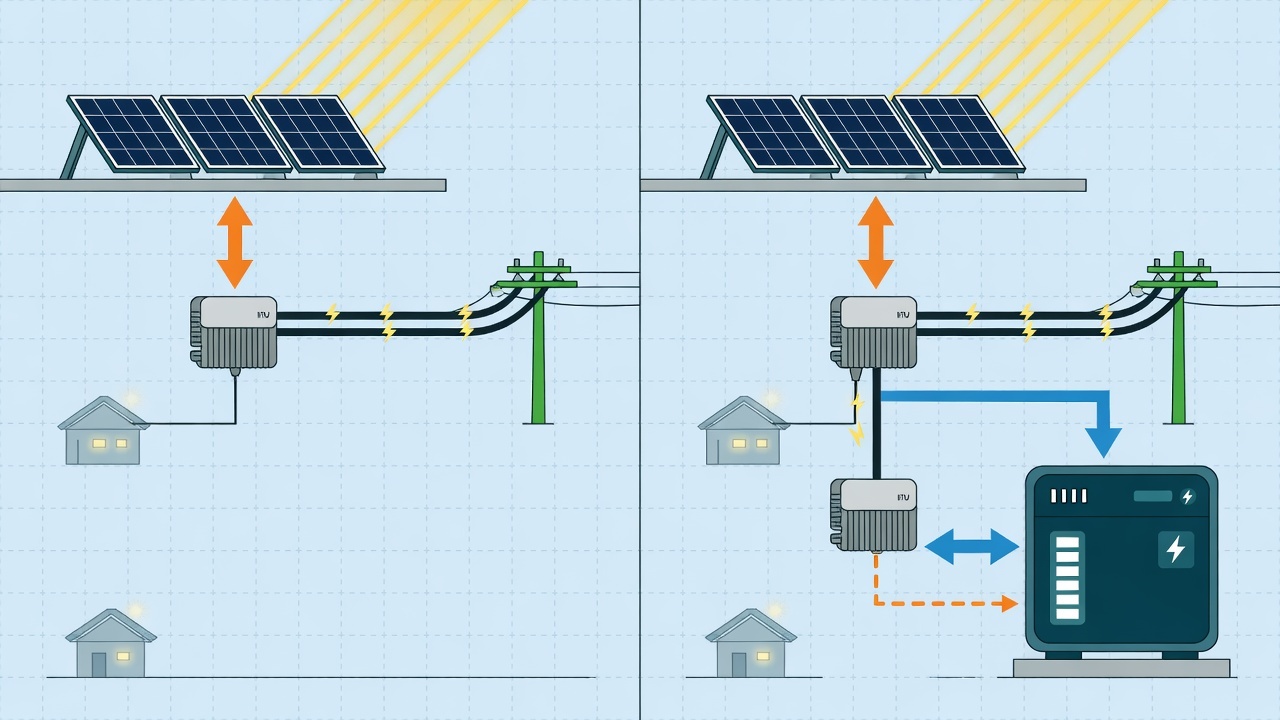
A battery-less system is the simplest PV installation: panels feed an inverter, and the inverter feeds the home and grid. No storage, no charge controller (for pure grid-tied), fewer components.
   PV Panels -> Inverter -> Home loads
                              |
                              +-> Grid
- Least expensive to install
- Fewest components and fewest failure points
- No backup power — energy is used or exported the moment it's produced
- Fully grid-dependent
System With Battery
Adding a battery introduces storage, allowing surplus solar to be used later and providing backup power. Requires a charge controller or a hybrid inverter.
   PV Panels -> Inverter/Charge controller -> Battery
                    |                         |
                    v                         v
               Home loads                 (night/outage supply)
                    |
                    +-> Grid (optional export)
- Higher upfront cost
- Provides backup and allows self-consumption
- More components to manage and maintain
- Battery has a limited lifespan and will need replacement
Cost and Payback
Without a battery, the investment is smaller and payback is usually faster. Adding a battery increases cost and extends payback — unless tariffs or outages make storage pay for itself.
  No battery:   lower cost, faster payback, no backup
  With battery: higher cost, slower payback*, backup + independence
  *payback improves with time-of-use pricing or frequent outages
Component Comparison
| Aspect | Without Battery | With Battery |
|---|---|---|
| Inverter | Grid-tied/string | Hybrid or + charge controller |
| Charge controller | Not needed | Required |
| Storage | None | Battery bank |
| Backup power | No | Yes |
| Maintenances | Low | Higher (battery) |
| Upfront cost | Lower | Higher |
When to Choose Each
Prefer NO battery when:
- The customer wants the lowest possible cost
- The grid is reliable and outages are rare
- The goal is simply to reduce the bill (feed-in tariffs work)
- The roof/system is small
Prefer WITH battery when:
- The customer wants backup during outages
- Time-of-use tariffs make self-consumption valuable
- Frequent blackouts are a real problem
- The customer values energy independence
Real-World Example
Two neighbors both install 6 kW systems. One chooses no battery: lowest cost, exports surplus, no backup, fast payback. The other adds a 10 kWh battery: survives outages, shifts solar into the evening, pays a bit more upfront but gains resilience and lower nighttime grid use.
Summary
- Without battery: simpler, cheaper, no backup
- With battery: more flexible, resilient, but costlier
- Pick based on cost goals, outage frequency, tariffs, and independence needs
- Component differences: charge controller/hybrid inverter and a battery bank
Next Lesson
Whatever the configuration, protection is non-negotiable. Let's cover string protection, disconnectors, and surge protection.
Quiz - Quiz - Installation With vs Without Battery
1. An advantage of installing a PV system WITHOUT a battery is...
2. An advantage of installing WITH a battery is...
3. Which factor most affects the payback period of a battery?