PV Panels: Types and Parameters
PV Panels: Types and Parameters
Introduction
Not all solar panels are the same. As an installer you need to choose the right panel technology and read its datasheet correctly — because every sizing decision downstream depends on those numbers. This lesson covers the common panel types and the crucial parameters you will use on any job.
Panel Technologies
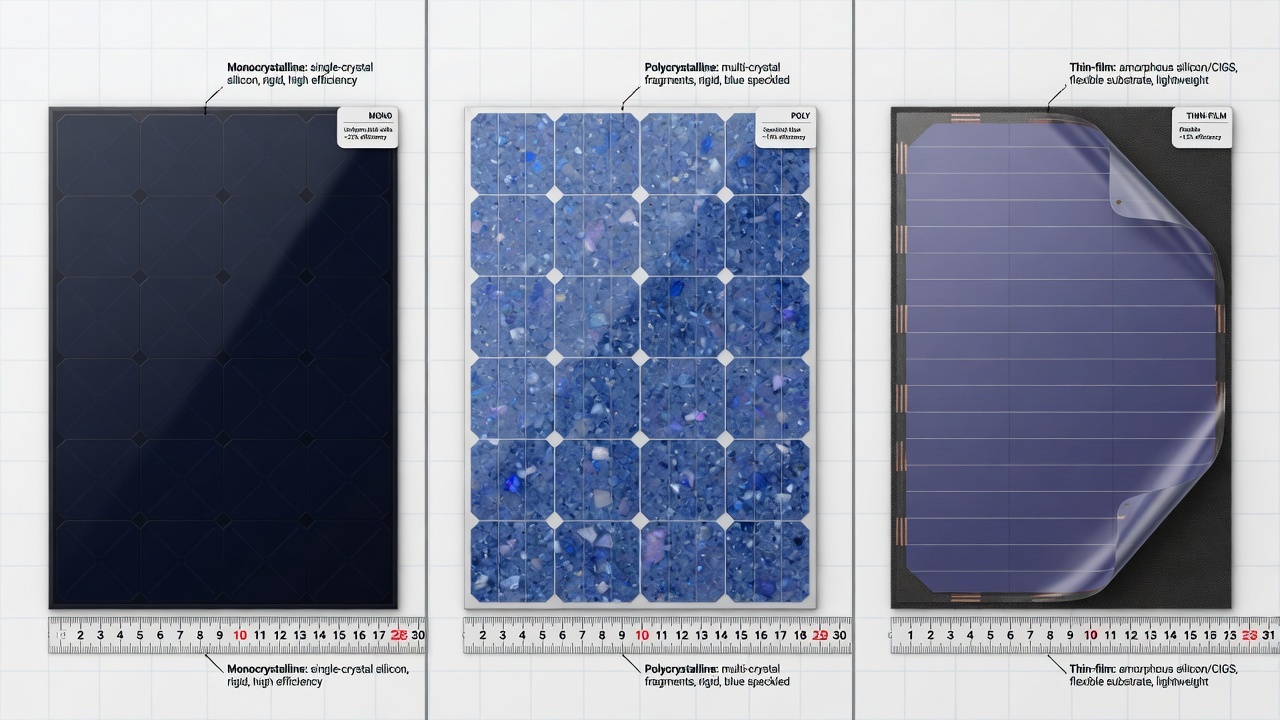
Monocrystalline Silicon
The most common and most efficient residential panel. Made from a single crystal structure, it has a uniform dark look and delivers the highest efficiency per square meter in typical conditions.
- Highest efficiency (often over 20%)
- Best performance in limited roof space
- Slightly higher cost per watt
Polycrystalline Silicon
An older technology made from multiple silicon crystals. It has a distinctive speckled blue appearance and slightly lower efficiency.
- Lower efficiency than mono
- Lower cost
- More panels needed for the same power
Thin-Film
A very different approach that deposits thin semiconductor layers on glass or flexible backing. Used mostly in large utility plants, building-integrated PV, and specialty applications.
- Lowest efficiency per area
- Can be flexible/lightweight
- Performs often better in high heat and low light
Key Datasheet Parameters
Every panel comes with a datasheet. The most important numbers:
Voc — Open-Circuit Voltage
The voltage the panel produces with no load (nothing connected). This is the maximum voltage the panel can ever produce and is critical for safe string design — you must keep string voltage below the inverter's maximum input voltage.
Vmp — Voltage at Maximum Power
The voltage the panel produces at its maximum power point. This is the operating voltage you expect in normal conditions.
Isc — Short-Circuit Current
The maximum current the panel can provide with its terminals shorted. Used to size fuses and cables.
Imp — Current at Maximum Power
The current the panel delivers at its maximum power point during normal operation.
Pmax — Maximum Power
The rated wattage of the panel, always measured under Standard Test Conditions (STC): 1000 W/m2 of light, 25 degrees Celsius cell temperature, AM 1.5 spectrum.
Datasheet example (typical 400 W panel)
  Pmax  = 400 W
  Voc   = 45.0 V        <- use for string voltage limit
  Vmp   = 37.0 V        <- normal operating voltage
  Isc   = 11.5 A        <- use for fuse/cable sizing
  Imp   = 10.8 A
  Eff   = 20.4 %
Temperature Effects
Panels lose voltage as they heat up. The datasheet gives a temperature coefficient, often around -0.3% per degree Celsius for Voc. On a hot day a panel's voltage can drop; on a cold morning it can rise well above the STC value. That is why installers must always design strings using the coldest expected temperature, never the datasheet nominal value.
V_actual = Voc + (T_actual - 25) x temperature_coefficient
Orientation and Tilt
To maximize energy, panels should point toward the sun:
- In the Northern Hemisphere, face them south
- Tilt is roughly equal to latitude for year-round optimum
- Shading from trees, chimneys, or other panels dramatically reduces output
Real-World Example
You are installing panels with Voc = 45 V on a roof where winter temperatures can reach -20 degrees Celsius. At that temperature the voltage rises (positive correction for colder than 25 degrees). You must calculate the cold Voc and confirm it stays below the inverter's maximum input voltage — otherwise you risk damaging the inverter.
Summary
- Monocrystalline is the common residential choice; poly and thin-film have their niches
- Voc, Isc, Vmp, Imp, and Pmax are the key datasheet numbers
- Voc/Isc drive safety sizing; Vmp/Imp drive operating design
- Temperature affects voltage — always design for the coldest case
- Orientation, tilt, and shading determine real-world output
Next Lesson
With panels understood, let's look at the full set of components that make up a complete PV system.
Quiz - Quiz - PV Panels: Types and Parameters
1. Which PV panel type is currently the most common for residential installations?
2. Voc on a PV panel datasheet refers to...
3. MPP (Maximum Power Point) is...