String Protection, Disconnectors and Surge Protection
String Protection, Disconnectors and Surge Protection
Introduction
Solar arrays carry real DC current and voltage, and they sit exposed on roofs where they can be hit by lightning. Proper protection — from string fuses to disconnectors to surge protectors — is what keeps people safe and equipment alive. This final lesson covers the essential protection devices on the DC side.
Why String Protection Is Needed
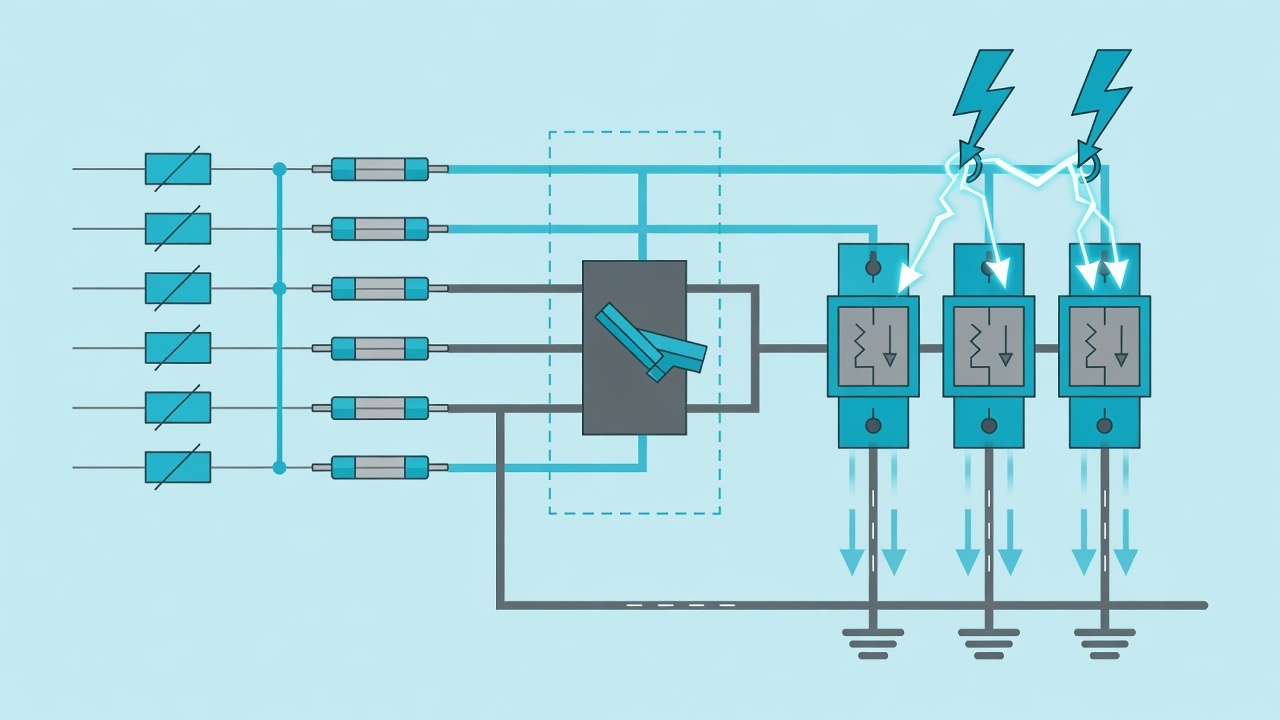
Multiple strings feeding a common bus create a hazard. If one string develops a fault (a short), the other healthy strings can back-feed current into the faulty string. Without protection, this overcurrent can overheat cables and start a fire or destroy panels.
The answer is overcurrent protection (fuses or breakers) on each string, sized to protect both the cable and the panel's maximum series fuse rating.
   String A ---[fuse]---+  <- each string independently fused
   String B ---[fuse]---+---> +DC bus -> inverter
   String C ---[fuse]---+
The DC Disconnect Switch
A DC disconnect is a manually operated switch that isolates the DC side. It's mandatory for:
- Safe maintenance — de-energize the panels before working
- Emergency response — cut power quickly if needed
- Compliance — required by most electrical codes
Fuses and Circuit Breakers
- Fuses — one-time protection, cheap, reliable
- DC circuit breakers — resettable, convenient for frequent isolation
Surge Protection
Surge protection devices (SPDs) guard against voltage spikes — most commonly from lightning, either direct strikes or nearby strikes that induce surges on long cable runs. A surge can instantly destroy inverters, charge controllers, and other electronics.
An SPD clamps the over-voltage and diverts the surge safely to ground.
   Incoming PV wires  ---[SPD]---+
                                  |
                                 === (to ground / earth)
SPDs are typically installed:
- On the DC side (between strings and inverter)
- On the AC side (at the distribution board)
- Located as close as possible to the equipment being protected
Grounding and Bonding
The whole protection scheme depends on proper grounding. Panels, mounting structures, and equipment must be bonded and grounded so fault currents and surges have a safe path. A poor ground makes fuses and SPDs ineffective.
Real-World Example
A lightning strike near a house induces a surge on the rooftop array. The DC SPD at the combiner clamps the spike and diverts it to ground before it reaches the inverter. Meanwhile, a fault in one string draws back-feed from the healthy strings — but that string's fuse blows, isolating the fault and saving the rest of the system.
Summary
- Fuses/breakers protect each string from overcurrent and back-feed
- A DC-rated disconnect isolates the DC side for safety and maintenance
- SPDs clamp lightning-induced surges and divert them to ground
- All of it depends on proper grounding and bonding
Congratulations!
You've completed the Photovoltaic Installer course! You now understand photovoltaics, panel parameters, on-grid vs off-grid vs hybrid architectures, inverters and MPPT, DC wiring, batteries, chemistries, and how to protect it all. You're well on your way to designing and installing safe, efficient solar systems.
Quiz - Quiz - String Protection and Surge Protection
1. Why do PV strings need DC protection (fuses/breakers)?
2. A DC disconnect switch is used to...
3. Surge protection devices (SPDs) protect the system from...