DC Solar, DC Battery and String Wiring
DC Solar, DC Battery and String Wiring
Introduction
The DC side of a PV system is where the raw solar energy lives — and where many mistakes happen. Understanding how strings are wired, how series vs parallel changes voltage and current, and how DC batteries connect is essential for a safe, efficient installation.
What Is a String?
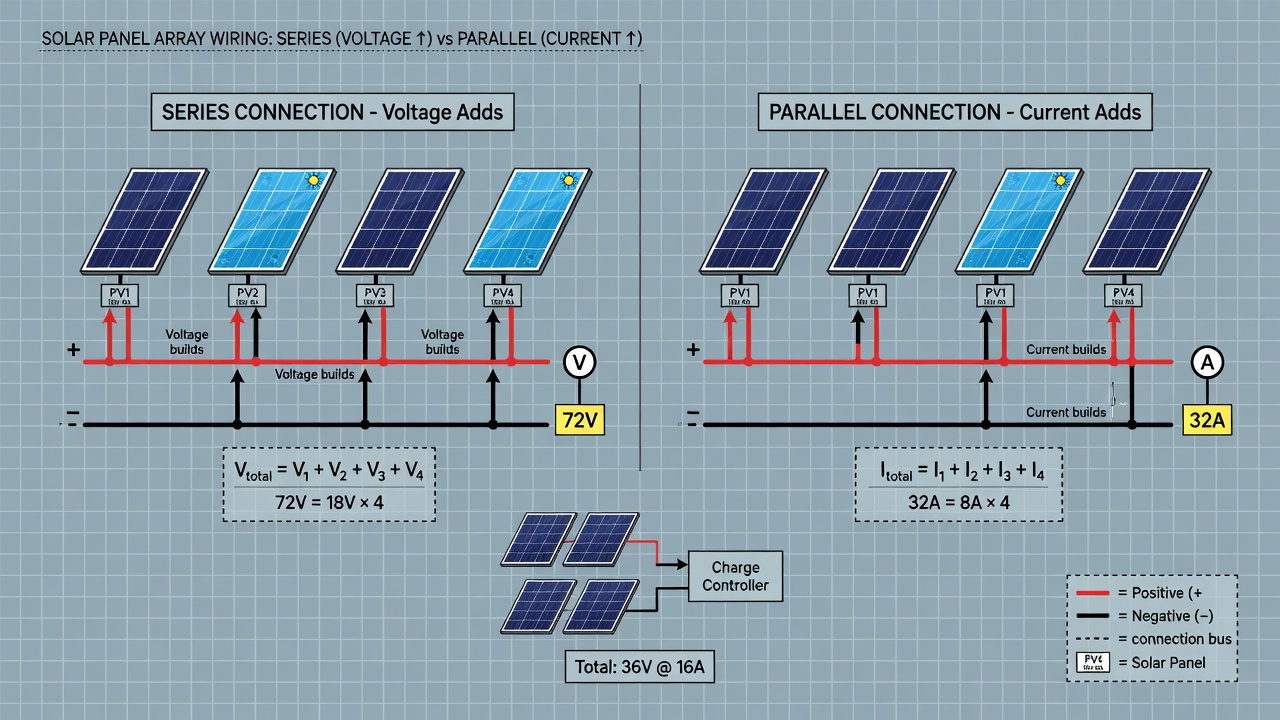
A string is a series connection of multiple panels. Panels in a string are connected positive-to-negative, one after another. Series wiring adds up the voltage while the current stays the same as a single panel.
  Panel 1     Panel 2     Panel 3
  (+)--[+]--(-)  (+)--[+]--(-)  (+)--[+]--(-)
          \_________/     \_________/
      Series: voltages add, current the same  e.g. 3 x 400 W panels (Vmp 37V, Imp 10.8A)
  = 111 V string, 10.8 A
Series vs Parallel
The choice of wiring determines your DC system's characteristics.
Series (string)
- Voltages add, current unchanged
- Raises voltage — good for reducing cable losses and matching inverter input
- A shaded panel in the string limits the whole string's current
Parallel
- Currents add, voltage unchanged
- Used to combine strings or increase current capacity
- Requires proper fusing to protect against back-feed
Series (voltages add):   [+p1-][+p2-][+p3-]  -> V = V1+V2+V3, I = same
Parallel (currents add): [   p1   ]  \
                         [   p2   ]  |-> I = I1+I2, V = same
                         [   p3   ]  /
Most residential systems use series wiring within a string, then combine multiple strings in parallel at the combiner box.
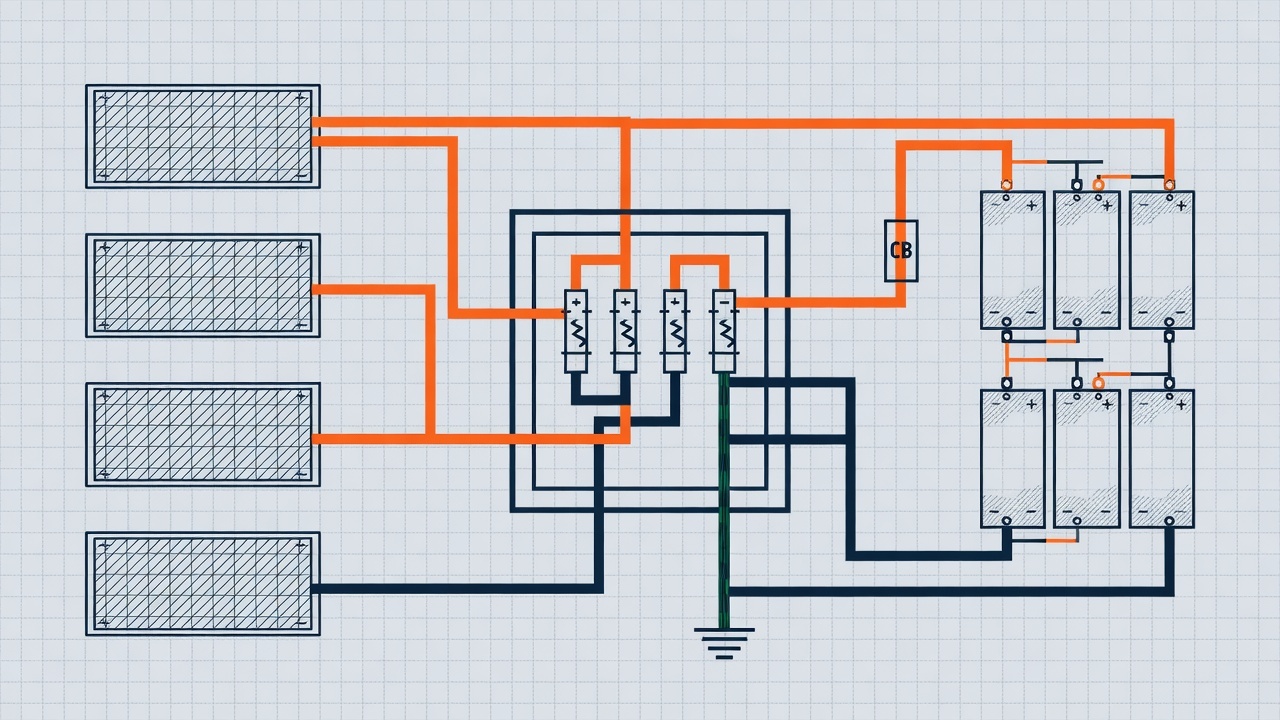
The DC Combiner Box
When multiple strings meet, a DC combiner box safely joins them. It provides:
- Fusing for each string (protects against overcurrent and back-feed)
- A common positive and negative bus
- Isolation points for maintenance
   String A ---[fuse]--+
   String B ---[fuse]--+--> +DC bus
   String C ---[fuse]--+
                              |
                          to inverter
DC Battery Connections
In battery systems, the battery bank connects to the DC side, typically through a charge controller or a hybrid inverter's DC input. Correct wiring matters:
- Match battery bank voltage to the system design (e.g., 48 V bank)
- Use proper cable sizing for the DC currents involved
- Include a disconnect so the battery can be isolated safely
- Watch polarity — a reversed battery connection is dangerous
   PV strings --> [MPPT/Charge controller] --> Battery bank
                                                 |
                                        [Battery disconnect]
Cable Sizing
DC cable sizing is a real safety factor:
- Undersized cables overheat and can start fires
- Use the panel's Isc and string current to size conductors
- Account for voltage drop over distance
- Use PV-rated, UV-resistant cables on the roof (pairs of red/black)
Fuses and Overcurrent Protection
Each string's fuse must be sized to protect the cable and the panel's maximum series fuse rating. Too big a fuse fails to protect; too small a fuse trips unnecessarily.
Real-World Example
You have 8 panels with Voc 45 V and Isc 11.5 A, arranged as two strings of 4. Each string is 4 × 45 = 180 Voc. Both strings connect at the combiner, where each gets a fuse sized for the cable and panels. Combined current at the inverter input is handled by the inverter's DC rating.
Summary
- A string is a series connection of panels; series adds voltage, parallel adds current
- The combiner box joins strings safely with fusing
- DC batteries connect to the DC side via a charge controller or hybrid inverter
- Cable sizing and fusing are critical for safety and efficiency
Next Lesson
Why do some systems have batteries and others don't? Let's define the role of batteries in PV systems.
Quiz - Quiz - DC Solar, DC Battery and String Wiring
1. A 'string' in PV terms is...
2. Connecting panels in series increases...
3. When multiple strings are combined, which component safely joins them?