The Role of Batteries in PV Systems
The Role of Batteries in PV Systems
Introduction
Batteries turn solar from a "when the sun shines" source into a genuinely useful, always-available power system. This lesson covers what a battery actually does in a PV system, how its chemistry and capacity shape the design, and when it's worth having one.
What a Battery Does
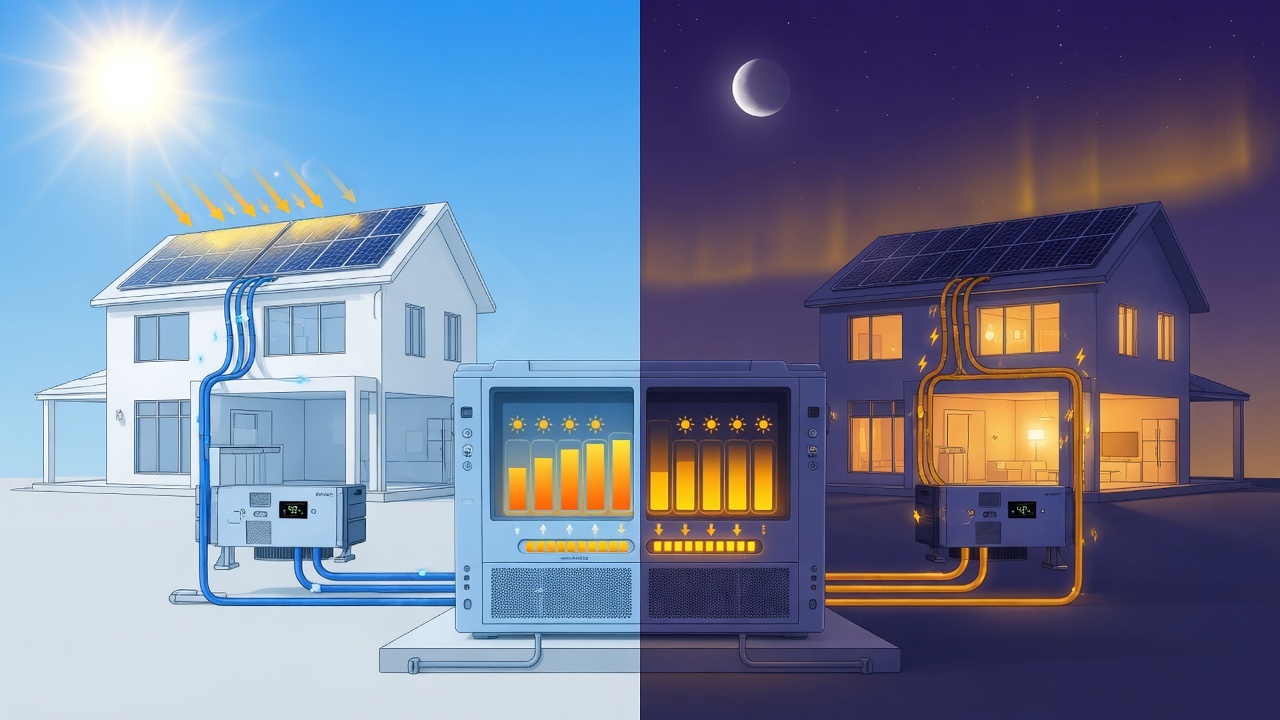
Solar panels only generate power during daylight. A battery's job is to store energy produced when there's surplus and release it when there's demand the panels can't cover — at night, during clouds, or during a grid outage.
   Daytime (sunny):   Panels -> power home + charge battery + export surplus
   Night / cloudy:    Battery -> power home
   Outage:            Battery -> power critical loads
Without storage, every kilowatt-hour you don't use the moment it's produced is either exported (on-grid) or wasted (off-grid, beyond loads).
Key Battery Concepts
Capacity (kWh)
How much energy the battery can store and deliver. Measured in kilowatt-hours. A 10 kWh battery can power a 1 kW load for 10 hours (theoretically).
Depth of Discharge (DoD)
What fraction of the battery's capacity you can actually use before recharging. Lead-acid is typically limited to ~50%; LFP can go to ~90-100%. Using more than the rated DoD shortens battery life.
Cycle Life
How many charge/discharge cycles the battery can handle before degrading. LFP often rates 4000-6000 cycles; lead-acid far fewer. This directly determines lifespan and cost-per-cycle.
Charge/Discharge Rate (C-rate)
How fast the battery can charge or discharge relative to its capacity. A 1C rate means it can fully charge/discharge in 1 hour.
When a Battery Makes Sense
The value of a battery depends on your goals:
In On-Grid Systems
- Self-consumption — store cheap/free solar surplus and use it when grid power is expensive
- Backup power — keep essentials running during outages (requires a hybrid inverter)
- It does NOT "save the planet more" by itself — its value is economic and resilience-based
In Off-Grid Systems
- The battery is essential — it's the only way to have power when the sun doesn't shine
- Without it the system is nearly useless
Battery vs No Battery — The Core Trade-off
A battery adds capability but also cost, complexity, and maintenance:
- No battery (grid-tied): cheapest, simplest, most efficient per dollar — but no backup and full grid dependence
- With battery: flexibility, resilience, self-consumption — but higher cost and the battery eventually needs replacing
Real-World Example
A homeowner has a 6 kW grid-tied array. Without a battery, they export surplus at midday and import at night — netting savings under a feed-in tariff. With a 10 kWh battery, they store the midday surplus and use it at night, avoiding buying expensive evening grid power (especially under time-of-use pricing), and they get backup during outages.
Summary
- A battery stores surplus solar and releases it when generation can't meet demand
- Key specs: capacity (kWh), depth of discharge (DoD), cycle life, C-rate
- In off-grid, the battery is essential; in on-grid it adds self-consumption and backup
- The trade-off is always cost/complexity vs flexibility/resilience
Next Lesson
The chemistry of the battery matters a lot. Let's compare lead-acid, LFP, NMC, and the new sodium-ion batteries.
Quiz - Quiz - The Role of Batteries in PV Systems
1. The primary role of a battery in a PV system is...
2. In an on-grid system, a battery mainly enables...
3. Battery capacity is most commonly expressed in...