Inverters: Types, Roles and MPPT
Inverters: Types, Roles and MPPT
Introduction
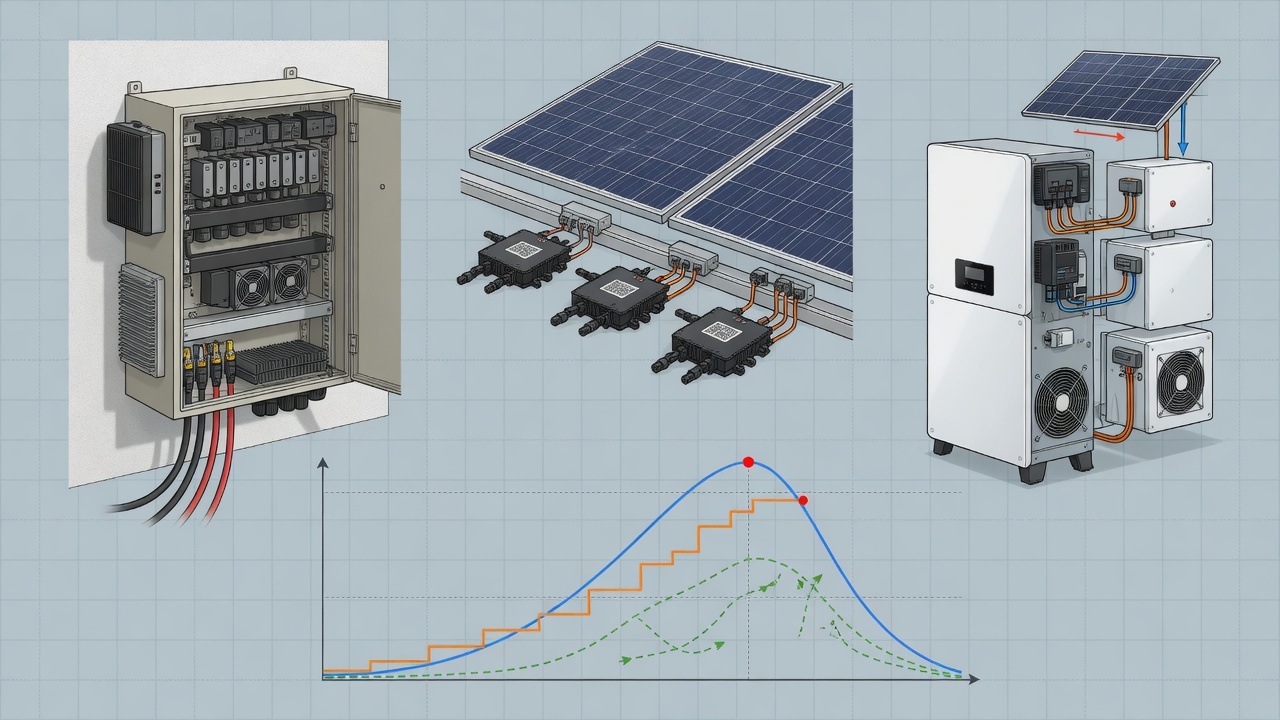
The inverter is the brain of a PV system. Everything on the AC side depends on it. This lesson covers what an inverter does, the main types you'll install, and how Maximum Power Point Tracking (MPPT) maximizes your energy harvest.
The Role of the Inverter
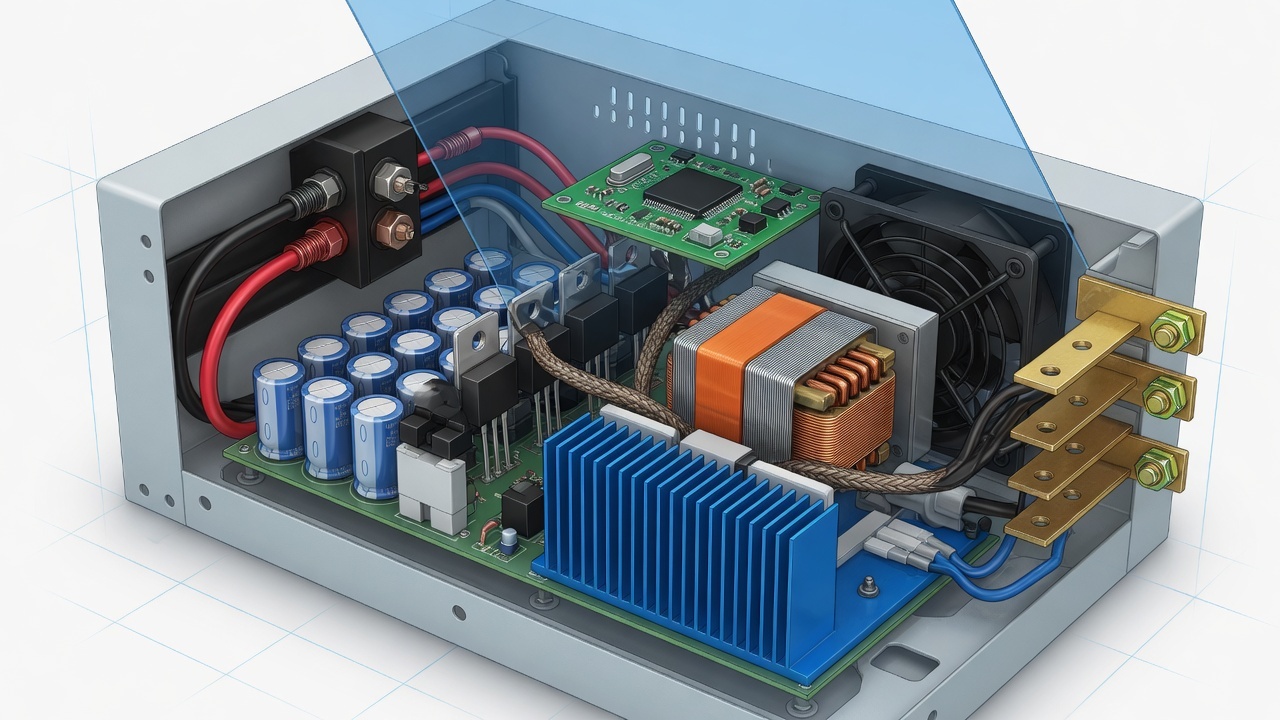
An inverter's primary job is to convert the DC power from the panels into AC power that matches the grid and can power conventional appliances. It also performs several safety and intelligence functions:
- Converts DC → AC at the correct voltage and frequency (e.g., 230 V / 50 Hz)
- Synchronizes with the grid (for on-grid operation)
- Tracks the maximum power point (MPPT)
- Monitors performance and logs data
- Enforces safety (anti-islanding, ground-fault detection)
   DC from panels  -->  INVERTER  -->  AC to loads/grid
                     [DC->AC, MPPT,
                      sync, safety,
                      monitoring]
Main Inverter Types
String Inverter
One central inverter handles the whole array. Strings of panels connect to its DC inputs. This is the most common and most cost-effective approach for residential and small commercial systems.
- Lowest cost per watt
- One point of failure for the whole array
- Great for unshaded roofs with consistent orientation
Microinverter
A small inverter is attached to each panel. Each panel runs independently.
- Each panel has its own MPPT — partial shading on one panel doesn't drag down others
- Excellent for complex or partially shaded roofs
- Easier to monitor per-panel
- Higher cost per watt than a string inverter
Hybrid Inverter
An all-in-one unit that combines a grid-tied inverter with battery management. Covered in the hybrid systems lesson — it's the go-to for systems with storage.
Power Optimizer + String Inverter
Optimizers sit under each panel (like microinverters) but feed DC into a central string inverter. Gives per-panel MPPT with the economy of a string inverter.
How MPPT Works
MPPT stands for Maximum Power Point Tracking. Solar panels have an optimal operating point — the "sweet spot" on the I-V curve where power output is maximum. This point changes constantly with light, temperature, and shading.
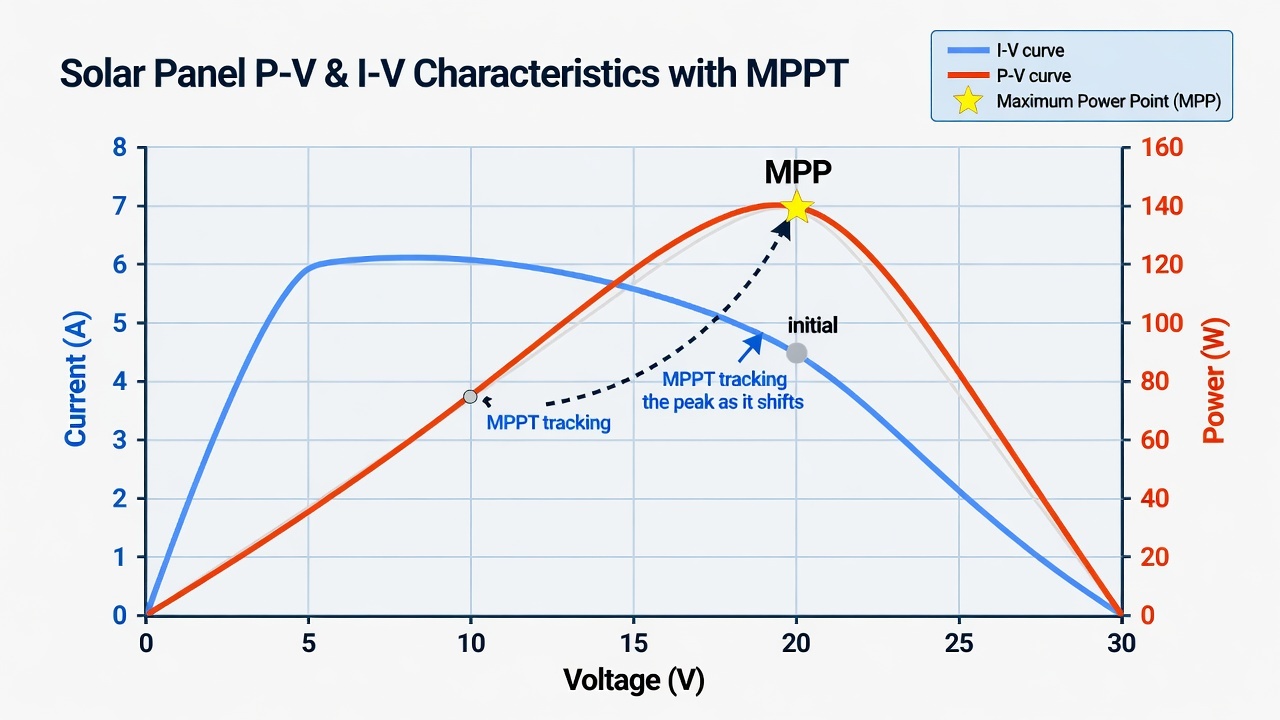
MPPT is a smart controller that continuously adjusts the operating voltage to stay at that peak, extracting the most power possible.
Without MPPT, a system loses a significant fraction of available energy, especially in variable conditions. This is why virtually all modern inverters and charge controllers include it.
Key Inverter Ratings to Check
- Max DC input voltage — must exceed your string's cold Voc
- Max DC input current — must accommodate your array's current
- Nominal AC output power — matches your expected load/export
- Number of MPPT trackers — more trackers help with multi-orientation roofs
- Efficiency — modern units are 97-99% efficient
Real-World Example
A roof has two orientations — south and west. An inverter with two independent MPPT trackers lets you connect each orientation to its own tracker, so each operates at its own optimum. A single tracker would force both to compromise.
Summary
- The inverter converts DC to AC and handles safety and monitoring
- String inverters are cheap and common; microinverters give per-panel optimization
- Hybrid inverters add battery management
- MPPT continuously tracks the panels' maximum power point for maximum yield
Next Lesson
Let's dive into the DC side in detail — DC solar, DC batteries, and how strings are wired.
Quiz - Quiz - Inverters: Types, Roles and MPPT
1. The main role of an inverter in a PV system is to...
2. What does MPPT do?
3. Which inverter type uses one small inverter per panel?