Probability Basics
Probability Basics
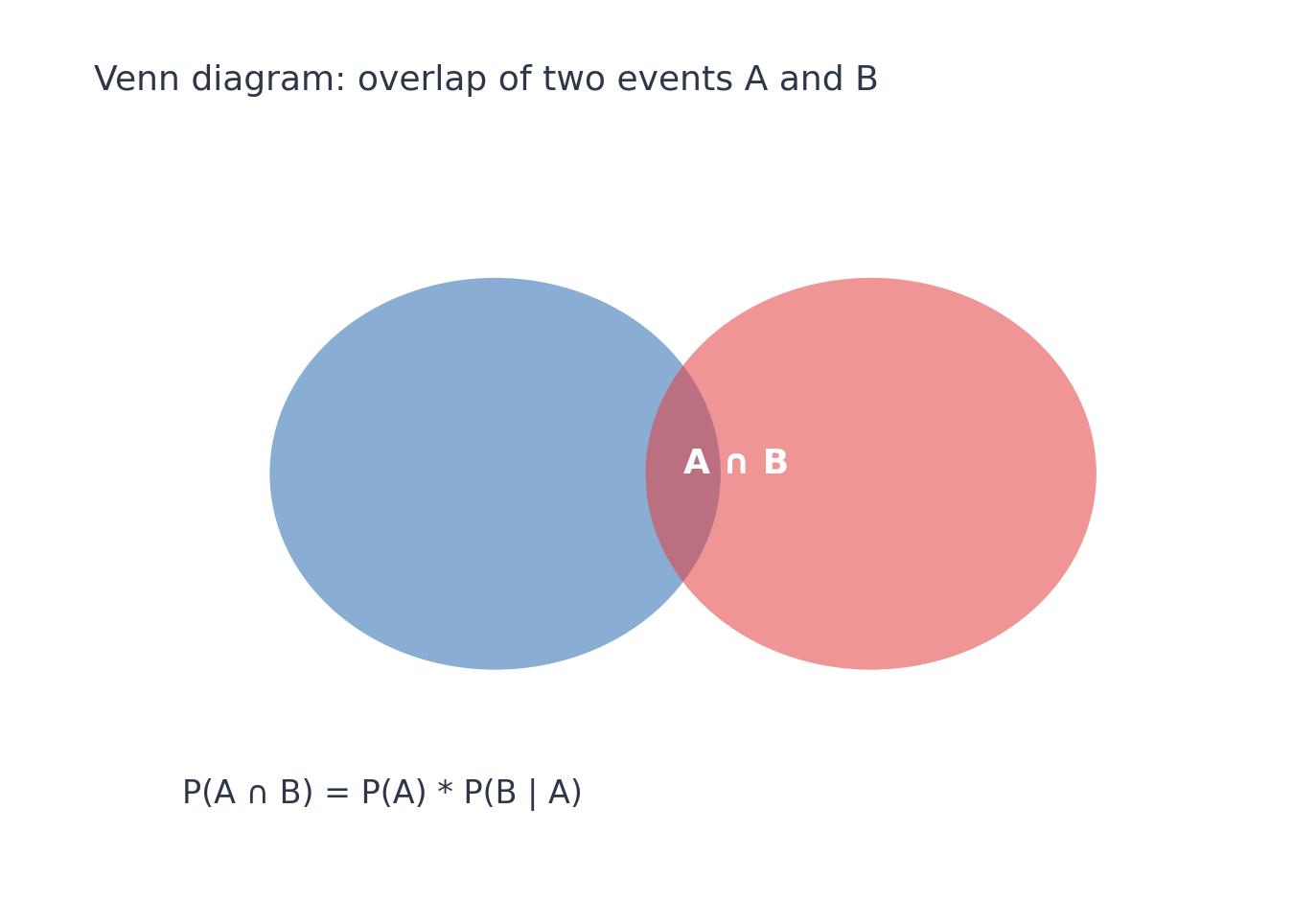
Introduction
Probability quantifies uncertainty with a number between 0 and 1. It is the bridge between descriptive statistics (what happened) and inferential statistics (what to expect). Understanding the basic rules here makes hypothesis testing later feel intuitive instead of magical.
Core Definitions
- Experiment: a process with uncertain outcomes (roll a die).
- Outcome: a single possible result (roll a 4).
- Event: a set of outcomes (roll an even number).
- Probability: P(event) = number of favorable outcomes / total outcomes (for equally likely cases).
import itertoolsProbability of rolling an even number with a fair die
outcomes = list(range(1, 7))
even = [o for o in outcomes if o % 2 == 0]
print(f"P(even) = {len(even)}/{len(outcomes)} = {len(even)/len(outcomes)}")
Output:
P(even) = 3/6 = 0.5
The Complement Rule
The probability an event does NOT happen is 1 minus the probability it happens:
P(not A) = 1 - P(A)
p_rain = 0.3
print(f"P(no rain) = {1 - p_rain}")
Output:
P(no rain) = 0.7
The Addition Rule
For two events that cannot happen together (mutually exclusive), the probability of A or B is the sum:
P(A or B) = P(A) + P(B)          (if mutually exclusive)
P(A or B) = P(A) + P(B) - P(A and B)   (general case)
p_mon = 1/7; p_tue = 1/7
print(f"P(Mon or Tue) = {p_mon + p_tue:.3f}")  # mutually exclusiveGeneral case: P(red card or king) in a deck
p_red = 26/52; p_king = 4/52; p_red_king = 2/52
print(f"P(red or king) = {p_red + p_king - p_red_king:.3f}")
Output:
P(Mon or Tue) = 0.286
P(red or king) = 0.538
The Multiplication Rule and Conditional Probability
For two independent events:
P(A and B) = P(A) * P(B) (if independent)
The general version uses conditional probability:
P(A and B) = P(A) * P(B | A)
P(B | A) = P(A and B) / P(A)
Example: Drawing Without Replacement
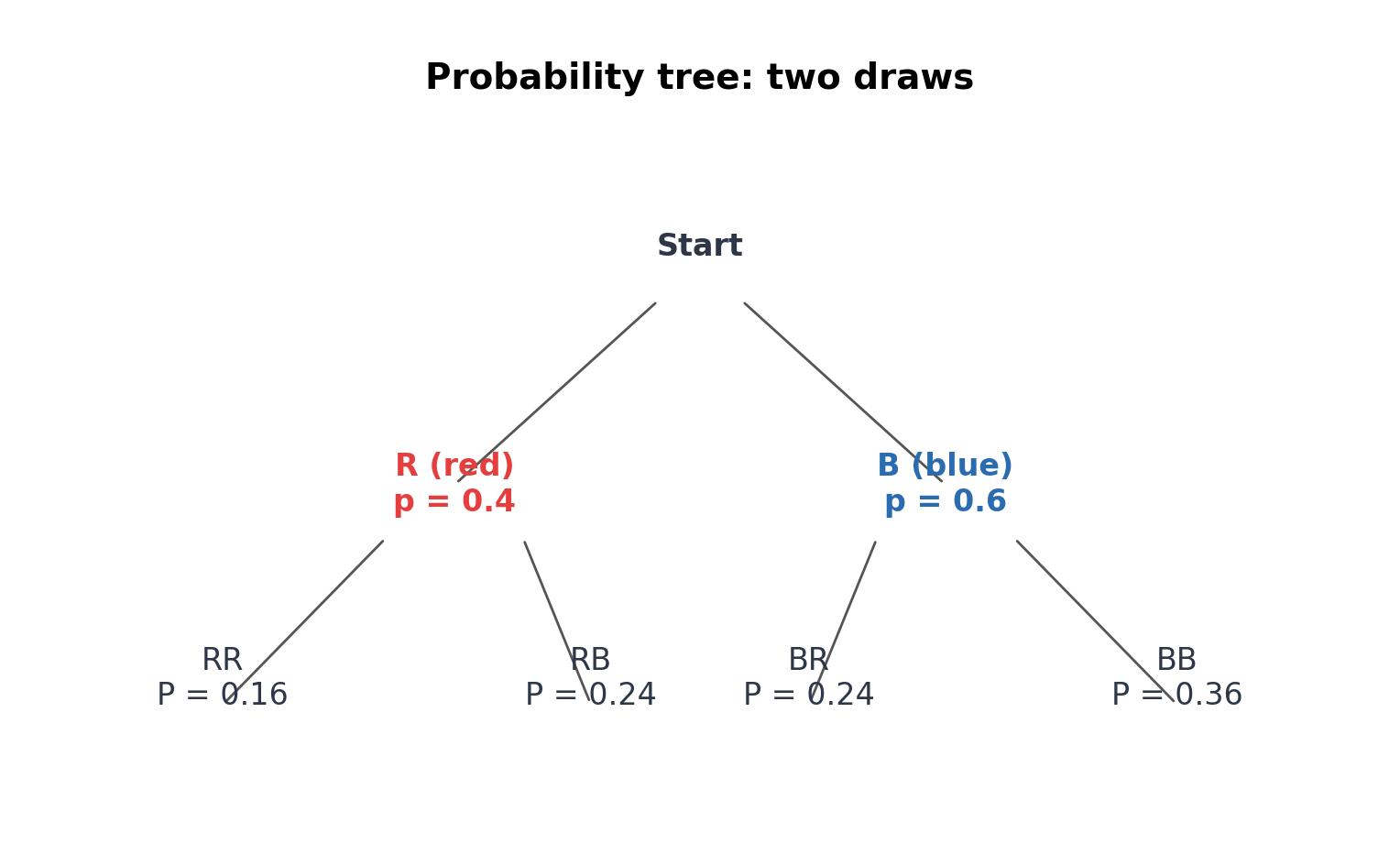
A bag has 4 red and 6 blue marbles. Draw two without replacement:
# P(first red) = 0.4
P(second red | first red) = 3/9
p_rr = (4/10) * (3/9)
p_rb = (4/10) * (6/9)
p_br = (6/10) * (4/9)
p_bb = (6/10) * (5/9)
print(f"P(RR) = {p_rr:.2f}, P(RB) = {p_rb:.2f}, P(BR) = {p_br:.2f}, P(BB) = {p_bb:.2f}")
print(f"sum: {p_rr + p_rb + p_br + p_bb:.2f}")
Output:
P(RR) = 0.13, P(RB) = 0.27, P(BR) = 0.27, P(BB) = 0.33
sum: 1.00
The probabilities of all outcomes always sum to 1 - a quick sanity check.
Independence
Two events are independent if knowing one happened does not change the probability of the other:
P(B | A) = P(B) (independence)
- Independent: coin flips, dice rolls, two separate website visitors.
- Dependent: drawing cards without replacement, disease prevalence given a test result.
Bayes' Rule (Preview)
Sometimes you know P(B | A) but need P(A | B). Bayes' rule flips the condition:
P(A | B) = P(B | A) * P(A) / P(B)
Example: Spam Filter
# Known: 2% of emails are spam; 95% of spam contains "free";
10% of all emails contain "free". What is P(spam | contains "free")?
p_spam = 0.02
p_free_given_spam = 0.95
p_free = 0.10
p_spam_given_free = (p_free_given_spam * p_spam) / p_free
print(f"P(spam | 'free') = {p_spam_given_free:.2f}")
Output:
P(spam | 'free') = 0.19
Even though "free" is common in spam, most emails containing "free" are not spam - because the base rate of spam is low. This is the famous base rate fallacy, and it trips up beginners constantly.
Common Pitfalls
- Adding probabilities of non-exclusive events without subtracting the overlap.
- Treating dependent events as independent (drawing without replacement!).
- Ignoring base rates when interpreting conditional probabilities.
Summary
- Probability runs from 0 to 1; complements sum to 1.
- Addition rule: P(A or B) = P(A) + P(B) - P(A and B).
- Multiplication rule: P(A and B) = P(A) * P(B | A).
- Conditional probability updates beliefs with new information.
- Base rates matter: P(A | B) is not the same as P(B | A).
Next Lesson
The most important distribution in statistics is next: the normal distribution, z-scores, and the 68-95-99.7 rule.
Quiz - Quiz - Probability Basics
1. The complement rule states that P(not A) equals:
2. Two events are called mutually exclusive if:
3. For events A and B, P(A and B) = P(A) * P(B | A). This is the:
4. Drawing two cards without replacement: the events are:
5. In the spam filter example, most emails containing 'free' were not spam because: